BBU Battery Bottleneck Beneficiaries
A source-backed view of Samsung SDI, Panasonic Energy, Murata, LG Energy Solution and adjacent power-infrastructure names after a public X thesis identified high-power cylindrical BBU cells as a possible AI infrastructure bottleneck.
Company Profile
The analyzable target is a listed supply-chain basket, not one mega-cap. Samsung SDI and Panasonic Energy supply cylindrical and energy-storage batteries; LG Energy Solution is a large Korean cell maker with 46-series cylindrical and ESS exposure; Murata supplies MLCCs, EMI filters and other components that can rise with AI-server and power-infrastructure builds. The adjacent U.S. names sell data-center power, electrical distribution, charging systems, and stored-energy equipment.
| Company | Ticker | Role in thesis | Evidence quality |
|---|---|---|---|
| Samsung SDI | KRX:006400 | High-power cylindrical and data-center BBU cells; also UPS and ESS exposure. | Official BBU/ESS materials plus The Elec industry-source article. Samsung SDI BBU |
| Panasonic Holdings / Panasonic Energy | TSE:6752 | Data-center energy-storage systems and cylindrical cell capacity. | Panasonic FY2026 filing says Energy sales rose on data-center ESS. FY2026 results |
| Murata Manufacturing | TSE:6981 | MLCC and server component demand as AI servers add electrical components. | FY2025 filing says MLCC revenue rose mainly in servers. Murata results |
| LG Energy Solution | KRX:373220 | 46-series cylindrical orders and North American ESS ramp. | Q1 2026 release cites >100GWh new 46-series orders and mid-20% ESS revenue mix. LGES Q1 |
China Competitors / Chinese Substitution
China has strong battery-cell, pack, BMS and energy-storage competitors, so the basket does not enjoy a global technical monopoly. The distinction is procurement context: U.S. hyperscaler and government-sensitive data-center deployments can value non-China sourcing, reliability documentation, and maintenance guarantees more than lowest cell cost. The Elec explicitly frames U.S. policy and Chinese battery restrictions as part of the sourcing backdrop. The Elec DoD 1260H list
| Chinese peer | Overlap | What it can substitute | Limit in this thesis |
|---|---|---|---|
| CATL | Large-scale lithium-ion cells and ESS. | Full technical substitute for many ESS and battery-cell use cases; 2025 sales were 661GWh and ESS shipments ranked first globally. CATL 2025 | Policy-sensitive U.S. data-center sourcing may still prefer Korean/Japanese suppliers. |
| Sunwoda | Battery packs, BMS, backup-power solutions for AIDC. | Module and system-level substitute in UPS / HVDC backup-power use cases. Sunwoda AIDC | Less direct public proof on the exact U.S. hyperscaler BBU cell channel named in the social thesis. |
| EVE / Desay / other China battery names | Cells, packs, BESS and backup-power systems. | Segment-level substitutes for cell, pack and energy-storage modules. | Evidence should be tied to specific customer programs before treating them as direct replacements. |
Conclusion: China has strong segment-level and often full product substitutes in batteries and ESS. The non-China basket is most differentiated where U.S. procurement, customer qualification, and cylindrical high-power BBU allocation matter.
Executive Summary
The positive case is credible enough to analyze because the social post ties a specific bottleneck, high-power BBU cells, to named listed suppliers and because official materials show data-center ESS, 46-series cylindrical batteries, and AI-server components are already showing up in company results. The stance is constructive but conditional: the basket needs contract evidence, customer visibility, and sustained margin capture.
| Question | Current read |
|---|---|
| Investment stance | Positive watchlist / selective basket; stronger for Samsung SDI and Panasonic Energy if the shortage is verified by orders. |
| What the market may miss | BBU cells sit closer to rack-level AI infrastructure than broad EV battery narratives, so the driver can be different from EV demand. |
| Most important caveat | The exact hyperscaler customer chain and supply tightness are still partly industry-source and social-source evidence. |
| Main proof needed | Named customer orders, backlog detail, utilization commentary, and pricing or margin evidence in 2026 results. |
Key Takeaways
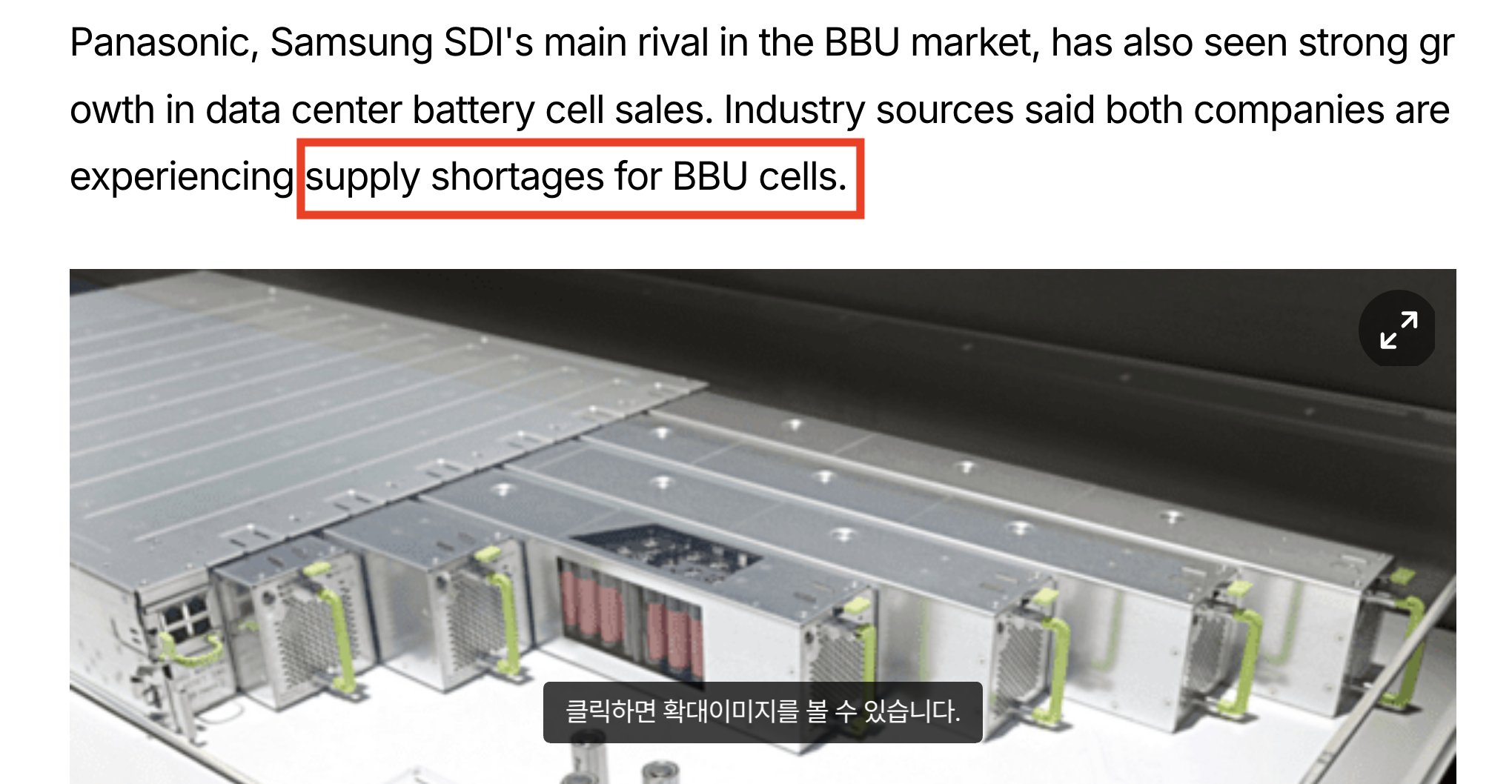
- Samsung SDI and Panasonic Energy are the cleanest cell-side expressions of the post because The Elec directly discusses their BBU cell shortage and Panasonic's official filing confirms data-center ESS growth.
- LG Energy Solution adds a more visible 46-series and North American ESS ramp, but Q1 2026 still showed an operating loss, so the proof is order conversion and cost down.
- Murata is a component read-through rather than a cell maker; its FY2025 results support server-led MLCC demand.
- VRT and ETN are higher-quality U.S. data-center power peers, while BWA and ENS are more adjacent and need more specific proof.
- China substitution is real at the product level. The relative advantage depends on customer qualification and non-China sourcing, not on a lack of Chinese technical capability.
Recent Two-Year Share Price Trend
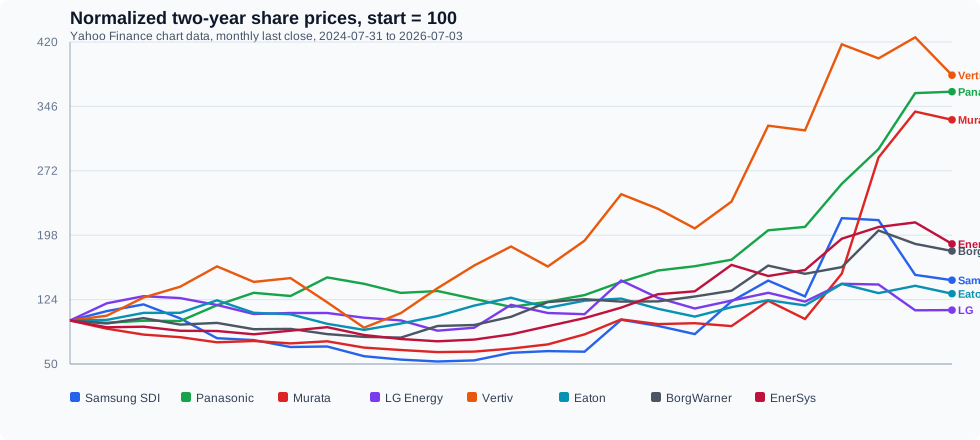
The chart normalizes each listed security to 100 at the start of the captured Yahoo Finance series. It is a basket comparison, not a single-company target price model. 006400.KS chart 6752.T chart 6981.T chart 373220.KS chart
| Ticker | Last captured price | Two-year change | Range in capture |
|---|---|---|---|
| 006400.KS | 467500.0 KRW | 46.3% | 168900.0 to 695000.0 |
| 6752.T | 4522.0 JPY | 262.9% | 1212.5 to 4522.0 |
| 6981.T | 11080.0 JPY | 230.6% | 2132.0 to 11395.0 |
| 373220.KS | 362500.0 KRW | 11.9% | 286000.0 to 473000.0 |
| VRT | 300.53 USD | 281.9% | 72.2 to 334.82 |
| ETN | 398.52 USD | 30.8% | 271.83 to 433.01 |
| BWA | 63.52 USD | 79.9% | 28.38 to 71.82 |
| ENS | 206.68 USD | 88.0% | 83.63 to 233.82 |
Market Context
Rack-level BBUs solve short-duration power instability inside dense AI-server environments. The social thesis is narrower than general batteries: it requires high power, compact form factor, qualification with pack assemblers, and customer confidence in maintenance. Samsung SDI's BBU explainer describes BBU batteries as a rising AI-era application, while The Elec says LFP has lower energy density and voltage than high-nickel NCA in the cylindrical form factor for this use case. Samsung SDI BBU The Elec
The demand driver is AI infrastructure. The weak link is size: the post itself cautions that not every shortage has a massive TAM. That caveat matters because even a real bottleneck can be too small to move a large diversified company unless it changes utilization, mix or pricing.
Company / Segment Quality
| Segment | Quality read | Why it matters |
|---|---|---|
| Samsung SDI battery | Cyclical and currently recovering; Q1 2026 revenue was KRW 3.58T with narrower operating loss according to the company. | A BBU mix benefit can help utilization and mix while EV demand remains uneven. Samsung SDI Q1 |
| Panasonic Energy | FY2026 Energy sales rose 13% to JPY 984.2B, but profit fell due to EV, tariffs, Kansas fixed cost and quality expenses. | Data-center ESS is a real positive offset, yet corporate margin is not a pure BBU story. Panasonic FY2026 |
| Murata components | FY2025 revenue rose 5% to JPY 1,830.9B, with MLCC revenue increasing mainly in servers. | Server-related component demand is official evidence for the read-through. Murata FY2025 |
| LGES cylindrical / ESS | Q1 revenue was KRW 6.6T; operating loss was KRW 207.8B; the company cites >100GWh of new 46-series orders and ESS as mid-20% of revenue. | Visible order momentum, but profitability and ramp costs remain the gating item. LGES Q1 |
Company-Specific Evidence
The strongest company-specific evidence belongs to Panasonic, LGES and Murata because their official filings directly mention data-center ESS, 46-series cylindrical batteries, ESS mix, or server components. Samsung SDI's exact BBU customer chain is still more dependent on The Elec and company category-level BBU material.
| Evidence | Status | Action in analysis |
|---|---|---|
| Samsung SDI cells to Simplo / Trend Power for BBUs | Reputable secondary / industry-source reporting. | Use as directional evidence; do not state customer contracts as company-confirmed. |
| Panasonic data-center ESS growth | Official filing. | Use as confirmed support for Panasonic's inclusion. |
| Murata server MLCC and EMI filter demand | Official filing. | Use as confirmed component read-through. |
| LGES 46-series and ESS orders | Official release. | Use as confirmed demand proof, with operating-loss caveat. |
Competitors
The peer set splits into cell makers, pack / system integrators, and data-center power infrastructure. A shortage in cells can benefit upstream suppliers first, while Vertiv and Eaton may gain if the bottleneck points to broader rack and electrical redesign. BorgWarner and EnerSys are plausible but less direct without program-level disclosures.
| Peer group | Names | Relative attractiveness |
|---|---|---|
| Core cell / battery | Samsung SDI, Panasonic Energy, LGES, CATL, EVE | Best match to the post, but cell economics need proof. |
| Components | Murata, other MLCC / power-component suppliers | Higher margin quality, lower direct BBU specificity. |
| Power infrastructure | Vertiv, Eaton | Already rerated AI infrastructure winners; valuation discipline matters. |
| Adjacent stored energy / mobility | BorgWarner, EnerSys | Possible second derivative, but thesis strength is lower from this post alone. |
Financial Statements
| Company | Latest financial anchor | Balance of evidence |
|---|---|---|
| Samsung SDI | Q1 2026 revenue KRW 3.58T and a narrower operating loss. | Cyclical battery earnings still matter; BBU must show mix contribution. |
| Panasonic Holdings | FY2026 consolidated sales JPY 8.05T; Energy sales JPY 984.2B, +13%. | Data-center ESS is a bright spot inside a restructuring year. |
| Murata | FY2025 revenue JPY 1.831T and operating profit JPY 281.8B. | Profitable component franchise with explicit AI-server demand support. |
| LGES | Q1 2026 revenue KRW 6.6T and operating loss KRW 207.8B. | Order momentum is ahead of earnings proof. |
Forecast / Operating Bridge
A conservative bridge should not assume the BBU shortage becomes a separate mega-market. The useful model is mix and utilization: higher BBU cell allocation can raise factory utilization, improve high-power cylindrical mix, and pull forward orders from pack/system customers. The bridge below is illustrative.
| Driver | Base case | Upside case | Evidence needed |
|---|---|---|---|
| Cell allocation | BBU is a niche but visible high-power line. | Shortage persists through 2026, lifting premium mix. | Company utilization and backlog commentary. |
| Customer proof | Industry-source customer chain remains partly opaque. | Named hyperscaler or pack customer orders appear. | IR call, press release, or filing detail. |
| Margins | Mix helps but EV and ESS ramp costs offset. | High-power cells carry better margin and less price erosion. | Segment margin and ASP commentary. |
| China sourcing | Non-China sourcing premium helps U.S. deployments. | Policy-sensitive customers lock long-term supply. | Contract duration and origin requirements. |
Valuation / Scenarios
Valuation should be basket-specific. Vertiv and Eaton already embed substantial AI infrastructure optimism. Samsung SDI, Panasonic and LGES still trade with battery-cycle and EV concerns, so the opportunity is more about incremental proof changing the earnings mix than about a simple scarcity multiple. Murata sits between the two: high-quality components, but the BBU tie is indirect.
| Scenario | Description | Implication |
|---|---|---|
| Bear | BBU shortage is temporary or too small; EV weakness and pricing pressure dominate. | Battery names do not rerate; U.S. power names de-rate if AI capex expectations cool. |
| Base | BBU and data-center ESS add mix support, but disclosures remain limited. | Selective positive stance; prefer names where data-center evidence is already official. |
| Bull | Named hyperscaler programs confirm sustained non-China high-power cell shortage. | Samsung SDI / Panasonic / LGES get a clearer AI infrastructure narrative; suppliers with capacity see higher utilization. |
Catalysts
- Samsung SDI and Panasonic earnings commentary on cylindrical cells, BBU, UPS or data-center ESS utilization.
- LGES updates on 46-series cylindrical backlog, Arizona ramp and North American ESS contracts.
- Murata server component orders, MLCC pricing and AI-server customer commentary.
- New disclosures from Simplo, Trend Power, hyperscalers, or data-center rack vendors.
- Policy updates that make non-China battery sourcing more or less valuable for U.S. customers.
Risks
- The exact customer chain is not fully company-confirmed, so a material part of the catalyst remains industry-source evidence.
- The TAM may be smaller than broad AI battery enthusiasm suggests; the social post itself warns against overgeneralizing every shortage.
- Chinese battery suppliers have strong technical capability and scale, which can cap global pricing power outside policy-sensitive channels.
- EV battery weakness, tariffs, ramp costs and quality expenses can overwhelm BBU positives in diversified battery companies.
- U.S. power infrastructure names may already price in a large AI capex cycle.
Questions for Management
- How much revenue now comes from BBU, UPS or data-center ESS customers, and how fast is it growing?
- Are high-power cylindrical cells capacity constrained, and which plants are the bottleneck?
- Do BBU cells earn better gross margin than EV cylindrical cells or commodity ESS cells?
- How long are customer qualifications and supply contracts for rack-level BBU use cases?
- How much of demand is driven by non-China sourcing requirements versus pure technical performance?
- Can customers dual-source from Chinese and non-Chinese suppliers without redesigning packs or rack power systems?
社交论点
原始推文:https://x.com/aleabitoreddit/status/2073763512216899825。Serenity 的核心判断是:机架级 BBU 使用的高功率圆柱电芯可能成为数据中心瓶颈。帖子把 Samsung SDI、Panasonic Energy、Murata、LG Energy Solution 列为主要受益者,同时把 Vertiv、Eaton、BorgWarner、EnerSys 视为相邻映射。公开原帖和镜像没有显示订阅墙。fxtwitter vxtwitter
| 主题 | 来源内容 | 分析含义 |
|---|---|---|
| BBU 电芯是瓶颈 | 社交帖称高功率圆柱电芯 / BBU cell shortage 看起来严重。 | 作者把短缺和具名供应商相连,达到中等以上正面信号。 |
| Samsung SDI 与 Panasonic | The Elec 报道 Samsung SDI 电芯经 Simplo / Trend Power 进入 BBU,并称 Samsung 与 Panasonic 面临 BBU 电芯短缺。The Elec | 方向得到外部报道支持,客户身份和经济弹性仍主要来自行业来源。 |
| Murata 与 LGES | Murata 是 MLCC / 组件映射,LGES 被列为 incoming。 | 两者是二阶受益者。LGES 有 46 系列与 ESS 订单证据,Murata 有服务器组件证据。 |
| 美国相邻标的 | $VRT、$ETN、$BWA、$ENS 被称为 adjacent read-through。 | 可做同业背景,信号强度低于亚洲电芯和组件标的。 |
证据状态:短缺、Simplo 供应链和美国科技客户信息来自 The Elec 与行业来源;各股票的受益幅度属于社交观点和基本面事实的推断。
公司概况
可分析标的是一个上市供应链篮子。Samsung SDI 与 Panasonic Energy 供应圆柱电芯和储能电池;LG Energy Solution 具备 46 系列圆柱电池和北美 ESS 产能;Murata 供应 MLCC、EMI 滤波器等 AI 服务器相关组件。美国相邻公司涉及数据中心供电、电气系统、充电和储能设备。
| 公司 | Ticker | 论点角色 | 证据质量 |
|---|---|---|---|
| Samsung SDI | KRX:006400 | 高功率圆柱电芯、数据中心 BBU、UPS 和 ESS。 | 官方 BBU/ESS 材料加 The Elec 行业报道。Samsung SDI BBU |
| Panasonic Holdings / Panasonic Energy | TSE:6752 | 数据中心储能系统与圆柱电池产能。 | Panasonic FY2026 文件显示 Energy 销售增长来自数据中心 ESS。FY2026 results |
| Murata Manufacturing | TSE:6981 | AI 服务器带来 MLCC 和服务器组件需求。 | FY2025 文件显示 MLCC 收入增长主要来自服务器。Murata results |
| LG Energy Solution | KRX:373220 | 46 系列圆柱电池订单和北美 ESS 爬坡。 | Q1 2026 公告披露超过 100GWh 新 46 系列订单,ESS 占收入 mid-20%。LGES Q1 |
中国竞对 / 中国替代
中国在电芯、电池包、BMS 和储能系统上有强竞争力,因此这个篮子没有全球技术垄断。差异主要来自采购语境:美国超大规模数据中心和政府敏感部署可能更重视非中国来源、可靠性文件和维护保障。The Elec 将美国政策和中国电池限制作为供应链背景。The Elec DoD 1260H list
| 中国同业 | 重叠能力 | 可替代环节 | 本论点限制 |
|---|---|---|---|
| CATL | 大规模锂电池和 ESS。 | 在许多 ESS 和电芯场景具备完整替代能力;2025 年销量 661GWh,储能出货全球第一。CATL 2025 | 政策敏感的美国数据中心采购仍可能偏好日韩供应商。 |
| Sunwoda | 电池包、BMS、AIDC 备用电源方案。 | 可替代 UPS / HVDC 后备电源中的模块和系统环节。Sunwoda AIDC | 公开资料对原帖提到的美国超大客户 BBU 电芯通道证明较少。 |
| EVE / Desay / 其他中国电池公司 | 电芯、电池包、BESS 和备电系统。 | 可在电芯、pack 和储能模块做局部或完整替代。 | 需要客户项目级证据后才能视作直接替代。 |
结论:中国在产品层面有强替代能力。非中国篮子的优势主要取决于客户认证、美国采购限制和高功率 BBU 产能分配。
执行摘要
该社交论点值得分析,因为它把一个具体瓶颈,高功率 BBU 电芯,和具名上市供应商相连;公司官方资料也显示数据中心 ESS、46 系列圆柱电池、AI 服务器组件已经进入财务披露。结论偏积极但有条件:需要合约、客户可见度和持续利润弹性验证。
| 问题 | 当前判断 |
|---|---|
| 投资态度 | 偏积极观察篮子;如果短缺被订单验证,Samsung SDI 和 Panasonic Energy 的直接性更强。 |
| 市场可能低估之处 | BBU 电芯更接近机架级 AI 基础设施,驱动因素可以不同于广义 EV 电池。 |
| 关键 caveat | 具体超大客户链条和供给紧张仍部分依赖行业来源。 |
| 主要证明 | 具名客户订单、backlog、利用率和价格/利润率说明。 |
核心要点
- Samsung SDI 与 Panasonic Energy 是最直接的电芯表达,因为 The Elec 直接讨论它们的 BBU 电芯短缺,Panasonic 官方文件也确认数据中心 ESS 增长。
- LG Energy Solution 具备更清晰的 46 系列和北美 ESS 爬坡,但 Q1 2026 仍亏损,关键是订单转化和成本下降。
- Murata 是组件映射,不是电芯公司;FY2025 结果支持服务器带动 MLCC 需求。
- VRT 和 ETN 是质量较高的美国数据中心电力同业,BWA 与 ENS 更相邻,需要更具体证明。
- 中国替代在产品层面真实存在。相对优势取决于客户认证和非中国来源要求。
近两年股价走势
下图把每个上市证券在 Yahoo Finance 捕获序列的起点归一化为 100。它是篮子比较,不是单一公司目标价模型。006400.KS chart 6752.T chart 6981.T chart 373220.KS chart
| Ticker | 最新捕获价格 | 两年变化 | 捕获区间 |
|---|---|---|---|
| 006400.KS | 467500.0 KRW | 46.3% | 168900.0 to 695000.0 |
| 6752.T | 4522.0 JPY | 262.9% | 1212.5 to 4522.0 |
| 6981.T | 11080.0 JPY | 230.6% | 2132.0 to 11395.0 |
| 373220.KS | 362500.0 KRW | 11.9% | 286000.0 to 473000.0 |
| VRT | 300.53 USD | 281.9% | 72.2 to 334.82 |
| ETN | 398.52 USD | 30.8% | 271.83 to 433.01 |
| BWA | 63.52 USD | 79.9% | 28.38 to 71.82 |
| ENS | 206.68 USD | 88.0% | 83.63 to 233.82 |
市场背景
机架级 BBU 用于缓冲高密度 AI 服务器的短时电力波动。这个论点比广义电池更窄,需要高功率、紧凑形态、电池包厂认证和客户维护信任。Samsung SDI 的 BBU 材料把 BBU 电池描述为 AI 时代应用;The Elec 则讨论高镍 NCA 圆柱电芯相对 LFP 在该形态下的功率和能量密度优势。Samsung SDI BBU The Elec
需求驱动来自 AI 基建。薄弱点在市场规模:原帖也提醒,不能把所有短缺都解释成巨大 TAM。即使瓶颈真实,如果无法改变利用率、产品 mix 或价格,对大公司利润影响也可能有限。
公司 / 分部质量
| 分部 | 质量判断 | 重要性 |
|---|---|---|
| Samsung SDI battery | Q1 2026 收入 KRW 3.58T,经营亏损收窄。 | BBU mix 可以帮助利用率和产品结构,但 EV 需求仍不均衡。Samsung SDI Q1 |
| Panasonic Energy | FY2026 Energy 销售增长 13% 至 JPY 984.2B,但利润受 EV、关税、Kansas 固定成本和质量费用拖累。 | 数据中心 ESS 是真实亮点,但公司利润不是纯 BBU 叙事。Panasonic FY2026 |
| Murata components | FY2025 收入 JPY 1.831T,经营利润 JPY 281.8B,MLCC 增长主要来自服务器。 | 组件业务质量高,服务器需求证据明确。Murata FY2025 |
| LGES cylindrical / ESS | Q1 收入 KRW 6.6T,经营亏损 KRW 207.8B;46 系列新订单超过 100GWh。 | 订单动能领先于利润验证。LGES Q1 |
公司特定证据
最强的公司特定证据来自 Panasonic、LGES 和 Murata,因为官方文件直接提到数据中心 ESS、46 系列圆柱电池、ESS 占比或服务器组件。Samsung SDI 的精确 BBU 客户链条仍更多依赖 The Elec 和品类级官方材料。
| 证据 | 状态 | 页面处理 |
|---|---|---|
| Samsung SDI 电芯经 Simplo / Trend Power 进入 BBU | 可靠二级来源 / 行业来源。 | 作为方向证据,不写成公司确认客户合约。 |
| Panasonic 数据中心 ESS 增长 | 官方文件。 | 作为 Panasonic 入选的确认支持。 |
| Murata 服务器 MLCC 和 EMI filter 需求 | 官方文件。 | 作为组件映射的确认支持。 |
| LGES 46 系列和 ESS 订单 | 官方公告。 | 作为需求证据,同时保留亏损 caveat。 |
竞对
同业分为电芯厂、电池包/系统集成商和数据中心电力基础设施。电芯短缺会先利好上游供应商;如果瓶颈带来机架供电架构变化,Vertiv 与 Eaton 也能受益。BorgWarner 与 EnerSys 有合理相邻性,但缺少项目级披露时信号较弱。
| 同业组 | 公司 | 相对吸引力 |
|---|---|---|
| 核心电芯 / 电池 | Samsung SDI, Panasonic Energy, LGES, CATL, EVE | 最贴近原帖,但需要证明电芯经济性。 |
| 组件 | Murata 等 MLCC / 电力组件供应商 | 利润质量较高,BBU 直接性较低。 |
| 电力基础设施 | Vertiv, Eaton | 已是 AI 基建赢家,估值纪律重要。 |
| 相邻储能 / 交通 | BorgWarner, EnerSys | 可能受益,但单靠此帖信号较低。 |
财务报表
| 公司 | 最新财务锚点 | 证据平衡 |
|---|---|---|
| Samsung SDI | Q1 2026 收入 KRW 3.58T,经营亏损收窄。 | 电池周期仍重要,BBU 需要显示 mix 贡献。 |
| Panasonic Holdings | FY2026 合并销售 JPY 8.05T;Energy 销售 JPY 984.2B,增长 13%。 | 数据中心 ESS 是结构亮点。 |
| Murata | FY2025 收入 JPY 1.831T,经营利润 JPY 281.8B。 | 盈利组件龙头,有 AI 服务器需求支持。 |
| LGES | Q1 2026 收入 KRW 6.6T,经营亏损 KRW 207.8B。 | 订单动能需要利润兑现。 |
预测 / 经营桥
保守经营桥不应假设 BBU 短缺自动成为超大市场。更合理的路径是 mix 和利用率:更高 BBU 电芯分配提升工厂利用率、改善高功率圆柱电芯组合,并拉动电池包和系统客户订单。下表为示意推导。
| 驱动 | Base case | Upside case | 需要的证据 |
|---|---|---|---|
| 电芯分配 | BBU 是小但可见的高功率产品线。 | 短缺延续到 2026,带来高端 mix。 | 公司利用率和 backlog 说明。 |
| 客户证明 | 行业来源链条仍不完全透明。 | 具名超大客户或电池包客户订单出现。 | IR call、公告或文件细节。 |
| 利润率 | 产品 mix 有帮助,EV 和 ESS 爬坡成本抵消。 | 高功率电芯利润率好于普通 EV 或商品 ESS 电芯。 | 分部利润率和 ASP 说明。 |
| 中国来源 | 非中国来源帮助美国部署。 | 政策敏感客户锁定长期供应。 | 合约期限和产地要求。 |
估值 / 情景
估值应按篮子处理。Vertiv 与 Eaton 已经包含较多 AI 基建乐观预期。Samsung SDI、Panasonic 与 LGES 仍受电池周期和 EV 担忧影响,机会更多来自盈利 mix 证据改变叙事。Murata 介于两者之间:组件质量高,但 BBU 联系更间接。
| 情景 | 描述 | 含义 |
|---|---|---|
| Bear | BBU 短缺短暂或市场太小;EV 疲弱和价格压力主导。 | 电池标的不重估;若 AI capex 预期降温,美国电力标的回撤。 |
| Base | BBU 和数据中心 ESS 提供 mix 支持,披露仍有限。 | 选择性偏积极,偏好已有官方数据中心证据的公司。 |
| Bull | 具名超大客户项目确认非中国高功率电芯持续短缺。 | Samsung SDI / Panasonic / LGES 得到更清晰的 AI 基建叙事,具备产能者利用率提升。 |
催化剂
- Samsung SDI 和 Panasonic 对圆柱电芯、BBU、UPS 或数据中心 ESS 利用率的业绩说明。
- LGES 对 46 系列圆柱 backlog、Arizona 爬坡和北美 ESS 合约的更新。
- Murata 服务器组件订单、MLCC 价格和 AI 服务器客户评论。
- Simplo、Trend Power、超大客户或机架电源供应商披露新信息。
- 政策变化使非中国电池来源对美国客户更有或更少价值。
风险
- 具体客户链条未完全由公司确认,催化剂仍部分来自行业来源。
- TAM 可能小于广义 AI 电池叙事;原帖也提醒不要把所有短缺都泛化。
- 中国电池供应商技术和规模很强,可能限制非政策敏感市场的价格弹性。
- EV 电池疲弱、关税、爬坡成本和质量费用可能覆盖 BBU 利好。
- 美国电力基础设施标的可能已经反映大量 AI capex 预期。
管理层问题
- BBU、UPS 或数据中心 ESS 客户当前贡献多少收入,增速是多少?
- 高功率圆柱电芯是否产能受限,瓶颈在哪些工厂?
- BBU 电芯毛利是否高于 EV 圆柱电芯或普通 ESS 电芯?
- 机架级 BBU 客户认证和供应合约周期有多长?
- 多少需求来自非中国来源要求,多少来自纯技术性能?
- 客户能否在不重做电池包或机架电源设计的情况下双供中外供应商?
Social Thesis
Original X/Twitter thesis: https://x.com/aleabitoreddit/status/2073763512216899825. Serenity argues that high-power cylindrical cells used in rack-level battery backup units have become a data-center bottleneck. The post names Samsung SDI, Panasonic Energy, Murata, and LG Energy Solution as the main beneficiaries, then treats Vertiv, Eaton, BorgWarner, and EnerSys as adjacent U.S. read-throughs rather than the author's core domain. The visible post and mirrors did not show a subscriber-only wall. fxtwitter vxtwitter
Claim status: the shortage, Simplo flow, and U.S. technology-company customer details are reported by The Elec and industry sources. The allocation of benefit across the named equities is investor inference from the social post plus company filings.