WULF / CIFR: AI infrastructure power bottleneck analysis
TeraWulf and Cipher Digital are credible public-market expressions of scarce US power and hyperscale AI data-center leasing, but the equity case still has to clear delivery, debt and dilution.
ViewConditionally positive
TargetsWULF / CIFR
WULF Q1 revenue$34.0M
CIFR Q1 revenue$35M
Next proof2026 MW delivery
Social Thesis
Original X/Twitter thesis. The post frames neocloud earnings as evidence that Michael Burry's GPU-depreciation concern is missing the contract and power side of AI infrastructure. The directly actionable under-covered target is TeraWulf / WULF; Cipher Digital / CIFR is a close peer and positive reference point because the post compares WULF's update with Cipher's AWS-backed HPC lease.
Claim or topic
Social-source wording
Verification and implication
WULF earnings
The post says WULF earnings were positive and cites $17B total contract value from 520 MW of HPC capacity.
TeraWulf's Q3 2025 release said it had signed more than $17B of long-term credit-enhanced customer contracts and executed more than 520 MW of long-term HPC leases TeraWulf Q3 2025 results. Later FY 2025 disclosure rounded the contracted platform to 522 critical IT MW and over $12.8B of revenue, so the contract value depends on gross versus ownership-adjusted framing TeraWulf FY 2025 results.
Texas JV
The post cites a 240 MW Texas joint venture and financing.
TeraWulf's Q3 2025 release described the Abernathy JV with Fluidstack and Google, initially designed for 240 MW with potential expansion to 600 MW and backed by Google credit support TeraWulf Q3 2025 results.
CIFR comparison
The post says WULF was not as special as CIFR's AWS earnings update.
Cipher announced an approximately $5.5B, 15-year lease with Amazon Web Services to deliver 300 MW of AI capacity, plus a 1 GW West Texas site plan Cipher Q3 2025 business update.
Burry / GPU depreciation
The post argues the GPU-depreciation critique is incomplete.
This is analysis, not an official fact. The key test is whether long-term leases, credit enhancement, power access and tenant obligations convert into cash returns after debt, dilution and construction risk.
Source-quality note: the original X URL is the social source. fxtwitter/vxtwitter were used only to preserve visible text when X public HTML was inconsistent; all material business claims below are checked against company releases and filings-style financial releases fxtwitter social-source mirrorvxtwitter social-source mirror.
Company Profile
TeraWulf owns and operates US digital infrastructure, historically tied to bitcoin mining and now repositioning toward power-backed HPC hosting. In Q1 2026 it said it generated $34.0M of revenue, including $21.0M of HPC lease revenue, with 60 MW of operational critical IT HPC capacity at Lake Mariner TeraWulf Q1 2026 results.
Cipher Digital develops industrial-scale data centers for bitcoin mining and HPC hosting. Cipher says its current strategy is to secure power, develop data centers purpose-built for HPC workloads and lease capacity to hyperscale customers; Q1 2026 revenue was $35M and adjusted EBITDA was negative $48M Cipher Q1 2026 business update.
Company
What it sells
Customer proof
Why it matters
WULF
Critical IT power capacity, data-center shell / hosting infrastructure, and legacy digital-asset mining.
Core42 capacity already generating revenue; Fluidstack / Google-backed Lake Mariner and Abernathy leases TeraWulf Q1 2026 results.
More operating HPC revenue today, but still heavy construction and financing exposure.
CIFR
Large-scale data-center campuses, turnkey space and power, and residual mining exposure.
Cleaner hyperscale data-center landlord story, but current revenue still mostly mining until leases ramp.
China Competitors / Substitution
China has strong IDC operators and cloud platforms, but it does not provide a full public-market substitute for a US power-backed campus owner signing US hyperscaler AI/HPC leases with Google-, AWS- or Fluidstack-linked counterparties. The closest China comps are segment substitutes: domestic IDC capacity, cloud AI demand, and power/cooling execution.
Chinese peer / segment
Overlap
Evidence
Substitution boundary
GDS Holdings
High-performance data centers in China and Asia.
GDS reported 2025 net revenue of RMB11.43B and adjusted EBITDA-style data-center economics in its FY 2025 results GDS FY 2025 results.
Large IDC platform, but customer jurisdiction, grid regime, contract law, tenant mix and US hyperscaler access differ from WULF/CIFR.
VNET
Wholesale and retail IDC capacity in China.
VNET reported 907 MW wholesale capacity in service and 869 MW committed as of March 31, 2026 VNET Q1 2026 results.
Comparable on capacity delivery, less direct on US hyperscaler AI lease economics.
Alibaba Cloud / other Chinese cloud operators
AI cloud demand and domestic compute utilization.
Alibaba Cloud said external cloud revenue growth accelerated to 40% YoY and AI-related products accounted for 30% of external revenue Alibaba Cloud FY2026 update.
Cloud demand validates AI compute growth, yet it is not the same investable exposure as owning US power sites leased to hyperscalers.
Conclusion: China offers partial substitution in IDC and cloud capacity. For the specific WULF/CIFR thesis, the investable bottleneck is US power, interconnection, construction financing and hyperscale lease execution.
Executive Summary
The analysis view is conditionally positive: WULF and CIFR are credible public-market ways to express the AI data-center power bottleneck, but the equity case depends on execution, financing cost and contract-to-cash conversion. The post's direction is supported by official disclosures; the unsupported part is any shortcut from headline TCV to equity value.
Item
WULF
CIFR
Current stance
Positive on operating progress; sensitive to debt, dilution and project delivery.
Positive on hyperscale lease proof; more back-end loaded cash conversion.
Company says it has sufficient capital for the third campus equity component and near-term needs; Q1 release also notes a $200M revolver Cipher Q1 2026 business update.
Next proof point
CB-3/CB-4/CB-5 and Abernathy delivery through 2026.
Barber Lake, Black Pearl and third-campus lease milestones through 2026-2027.
Key Takeaways
WULF has moved beyond a pure bitcoin-mining narrative: Q1 2026 HPC lease revenue already contributed $21.0M TeraWulf Q1 2026 results.
Power is the scarce input. Uptime Institute's 2025 survey highlights rising costs, power constraints and AI demand challenges across the data-center industry Uptime Institute 2025 survey.
Headline contract value should be converted into ownership-adjusted revenue, lease start dates, financing costs, maintenance capex and share dilution before drawing an equity conclusion.
China has strong domestic substitutes for IDC and cloud capacity, but the US hyperscaler lease / US grid bottleneck is not fully replicated by Chinese listed peers.
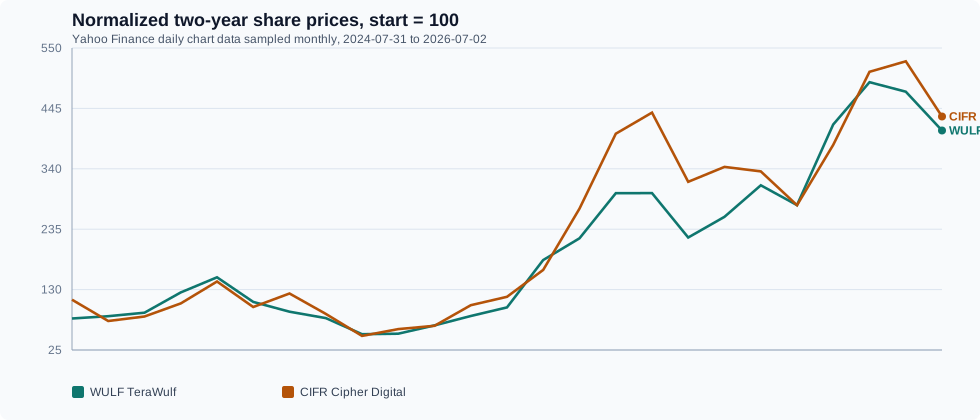
The chart matters because both stocks have already rerated with the AI infrastructure narrative. New capital is no longer buying a hidden mining-to-AI pivot; it is underwriting delivery, financing cost and tenant-credit proof after a large move.
Market Context
AI training and inference workloads push demand toward dense power, cooling, interconnection and site execution. In this market, the bottleneck is not only GPUs; it is the ability to turn land, grid access, substations, financing and construction into usable critical IT load. Uptime Institute's 2025 survey describes the sector as facing rising costs, worsening power constraints and AI-related challenges Uptime Institute 2025 survey.
Driver
Positive read-through
Counter-evidence to monitor
Hyperscaler demand
AWS, Google-linked Fluidstack and other customers are signing long-duration capacity agreements.
If hyperscalers self-build faster or renegotiate terms, scarcity pricing can fade.
Power and interconnection
Sites with ready or near-ready power can command strategic value.
Grid queues, local permitting, equipment lead times and community opposition can push revenue out.
Financing
Credit-enhanced leases can support project-level debt.
High coupons, convertibles and equity issuance can transfer value away from common shareholders.
Company / Segment Quality
Segment
WULF quality read
CIFR quality read
HPC leases
Q1 lease revenue shows the model has begun to operate, with 60 MW energized at Lake Mariner TeraWulf Q1 2026 results.
Cipher completed three bond offerings for aggregate proceeds of $3.73B in FY 2025 update Cipher FY 2025 business update.
Project finance validates the contracts but can cap common-equity upside if returns are debt-heavy.
Forecast / Operating Bridge
The bridge below is illustrative and should not be read as company guidance. The logic is to track contracted critical IT MW into delivered MW, delivered MW into rent start, rent start into EBITDA, then subtract interest, maintenance capex and dilution.
Bridge step
Base case marker
Upside marker
Failure marker
Capacity delivery
WULF and CIFR deliver scheduled 2026 phases with small slippage.
Additional 250-500 MW annual contracting for WULF and additional hyperscale leases for CIFR.
Grid or construction delays push rent starts beyond expected windows.
Revenue conversion
HPC leases become the majority revenue driver by 2027.
Tenant expansions and annual escalators improve recurring revenue visibility.
Mining remains a large revenue share for longer than expected.
Financing
Debt service covered by tenant-backed contracted revenue.
Lower refinancing cost after projects are operating.
High-yield coupons and convertibles absorb most economics.
Valuation / Scenarios
For WULF and CIFR, EV/revenue based on today's mining revenue is not very informative. A cleaner lens is capacity-based: value delivered and contracted critical IT MW after deducting construction cost, debt, partner economics and dilution.
Scenario
What must happen
Equity implication
Downside
Construction delays, higher capex, tenant onboarding slippage, or weak lease economics.
Headline TCV fails to protect the common stock; multiples compress.
Base
2026 projects are delivered broadly on schedule; cash burn is funded without major new equity shock.
Stocks can hold a premium as scarce-power infrastructure platforms.
Upside
New customers sign at attractive rents, delivered MW grows faster than debt, and operating EBITDA scales.
Re-rating can continue, with WULF helped by current HPC revenue and CIFR by hyperscale tenant proof.
Catalysts
Quarterly disclosure of delivered critical IT MW, rent commencement and HPC lease revenue.
WULF CB-3/CB-4/CB-5 and Abernathy construction milestones through 2026.
CIFR Barber Lake and Black Pearl delivery updates, AWS phase delivery and any additional hyperscale lease.
这张图的含义是:两只股票已经随着 AI 基础设施叙事大幅重估。新资金买到的不是未被发现的挖矿转 AI 逻辑,主要是在押注交付、融资成本和租户信用继续兑现。
市场背景
AI training 和 inference 工作负载拉动高密度电力、制冷、互联和站点交付需求。瓶颈不只在 GPU,还在于把土地、电网接入、变电站、融资和建设能力转换成可用 critical IT load。Uptime Institute 2025 调查称行业面对成本上升、电力约束恶化以及 AI 需求带来的挑战 Uptime Institute 2025 survey。
Social Thesis
Original X/Twitter thesis. The post frames neocloud earnings as evidence that Michael Burry's GPU-depreciation concern is missing the contract and power side of AI infrastructure. The directly actionable under-covered target is TeraWulf / WULF; Cipher Digital / CIFR is a close peer and positive reference point because the post compares WULF's update with Cipher's AWS-backed HPC lease.
Source-quality note: the original X URL is the social source. fxtwitter/vxtwitter were used only to preserve visible text when X public HTML was inconsistent; all material business claims below are checked against company releases and filings-style financial releases fxtwitter social-source mirror vxtwitter social-source mirror.